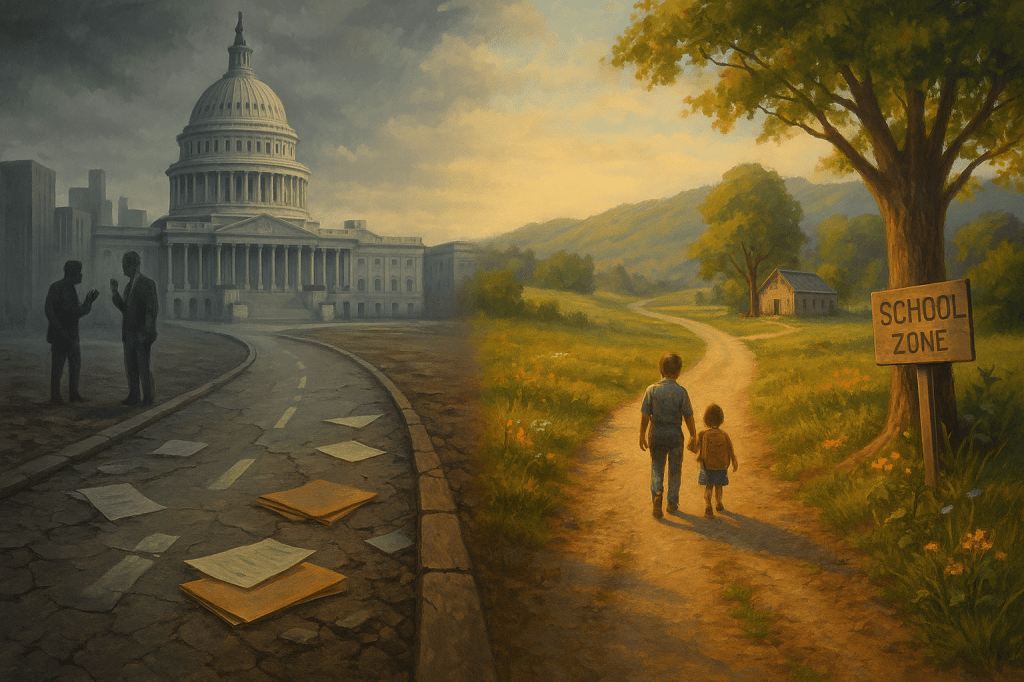
We say children are the future, but when did that future become a bargaining chip?
Somewhere along the way, policies meant to protect and nurture the next generation started getting lost in the noise of party politics. Bills that could improve children’s health, education, and emotional well-being are debated less on their value and more on who drafted them. One side introduces it, the other dismisses it. Not because it lacks merit, but because it wasn’t their idea.
But children don’t wear party pins. They don’t cast votes. They don’t choose sides. They just live with the consequences.
The quote wasn’t new, but its truth is finally catching fire. “Children aren’t Democrats or Republicans,” Robert F. Kennedy Jr. said months ago, during a moment that many overlooked at the time. But now, the weight of those words is settling in. It’s a reminder we needed. Before a child can vote, argue policy, or be labeled by ideology, they are simply that: a child.
And when it comes to legislation that directly impacts their future, we ought to be asking one central question: Is this good for them?
Not, does it align with our political platform?
Not, will it gain or cost us votes?
But simply, will it help children thrive?
Across West Virginia, we’ve seen glimpses of what it looks like when lawmakers put children before partisanship. In March 2025, Governor Patrick Morrisey signed House Bill 2354, a first-of-its-kind law banning seven synthetic food dyes from school meals. That ban took effect on August 1, impacting approximately 240,000 public school students. Starting January 1, 2028, the same ban will extend to all food products sold in the state, including two preservatives: BHA and propylparaben. This marks the first law of its kind in the country.
Supporters of the bill pointed to growing research connecting these dyes to neurobehavioral issues in children. Critics noted the FDA still considers them safe in approved amounts. But at the heart of the debate was a question that cut through the politics: if there is even a chance that removing these additives could help a child focus better, sleep more soundly, or feel more regulated, isn’t that worth it?
In towns like Middlebourne and Sistersville, school leaders quietly got to work. They swapped neon-colored fruit snacks for fresh orange slices and offered spaghetti with homemade tomato sauce instead of prepackaged trays. The smell of warm rolls still fills the cafeteria, but the labels no longer list colors with numbers beside them. These changes may seem small, but they send a clear message. Our children’s well-being matters more than convenience.
But child health goes beyond what’s served on a lunch tray. It also includes where a child sleeps at night, how often they’re moved, and whether they feel seen, heard, and safe in the place they call home.
Earlier this year, West Virginia also passed a comprehensive foster care reform package. It brought together efforts to reduce placement instability and ensure children in care have consistent access to support. One companion measure, House Bill 3182, addressed something often overlooked: how children carry their belongings from home to home. The bill now requires that foster children be provided with proper luggage, such as a suitcase, duffel bag, or backpack, so their personal items are treated with care and dignity.
There are no more black trash bags slumped on porches or handed over in the dark of night. Now, a child can zip up a suitcase and carry something that feels like their own, even if the address is changing again. A suitcase may not solve the system’s deepest issues, but it tells a child: you matter.
In West Virginia, our legislators work hard to create meaningful solutions that reflect the values of the people they serve. Whether it’s improving access to mental health care, supporting foster families, or ensuring safe meals in our schools, their efforts are shaped by the needs of our children and communities.
That stands in stark contrast to what we often see on the national stage, where legislation meant to protect or uplift children is too frequently stalled, stripped down, or spun into partisan talking points. Bills focused on child nutrition, school safety, or early intervention services are debated less for their content and more for who introduced them. Instead of collaboration, there is contention. Instead of urgency, delay.
While Washington argues, West Virginia is acting. And if we can find common ground here, in the hills and hollers of our state, then there is no excuse for gridlock in the nation’s capital.
These policies take on deeper meaning in rural communities like Tyler County, where resources are fewer and the impact of every decision feels closer to home. In partnership with community providers, schools have worked to adapt not just meal offerings, but the overall approach to student wellness. Families are learning about the dye-free initiative through newsletters, open houses, and one-on-one conversations. Children are learning that food can be both good for them and comforting.
Local foster and kinship families are also feeling the difference. Regional programs based in Paden City and New Martinsville offer more than services. They offer safe places: a quiet room where a child can color while a counselor helps them find the words for what they’ve been through, a cup of cocoa on a worn desk during intake, a case worker who notices when a child’s shoes are too tight, or when they’ve been wearing the same hoodie two visits in a row.
And that is the thread that ties it all together. These are not policies about cities or towns, north or south, red or blue. They are about doing what is right by the next generation, wherever they live and whoever their families voted for.
So the next time a bill comes forward, no matter who drafts it, may we ask the right questions. May we fight for what is just, not just what is partisan. May we stop using children as political leverage and start treating them as the reason we must come together.
Because they are not Democrats.
They are not Republicans.
They are just children.
They are the little girl twirling on the sidewalk in front of the courthouse. The boy with dirt under his fingernails and a backpack too heavy for his shoulders. They are just children. And they are counting on us to act like grown-ups.
 In the quiet
Leave a comment