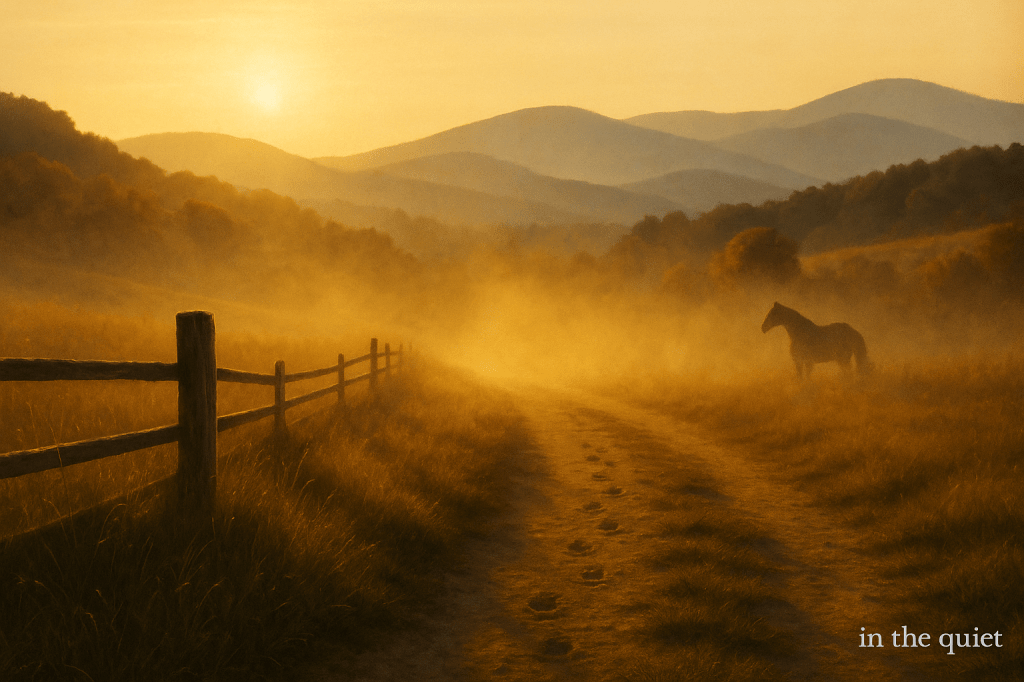
There is an old proverb about a farmer whose horse ran away. It was his only horse, the one he depended on to plow the fields and carry his burdens. When the neighbors heard the news, they came to console him. They shook their heads and said, “Such terrible luck.” The farmer, calm and steady, answered only, “Maybe so, maybe not.”
The dust still hung in the air where the horse had been, and the field stood empty and quiet. I imagine the dust settling the way it does on a long gravel road back home, drifting slow in the sunlight, refusing to fall all at once. That is where I want to begin, at the moment of loss, when the ending has not yet revealed itself and silence is the only thing you can hear. All you know is what has vanished, not what might rise in its place.
I did not know this proverb when I was young, yet its truth had already begun rooting itself in the corners of my life.
I was 18 when I learned I was expecting. At 19, I brought my first son into the world during a snowstorm that blanketed the valley in a heavy white hush. Flakes the size of nickels drifted past the hospital window, settling on the empty parking lot like a quiet blessing. The roads were sealed under ice and prayer, and the air tasted cold enough to crack. Inside that small room, warm from the steady hum of the heater, I held a newborn whose cry softened the storm itself. I remember thinking how tiny his fingers were, how new his breath felt against my skin, and how the world outside seemed to pause as if honoring the courage it took to bring him into it.
By 20, I had spoken vows with trembling hope, believing we were building something lasting. At 21, a crib sat tucked beside our bed and lullabies drifted into the dark as I tried to steady a home that already felt fragile. By 23, the marriage had unraveled, and I found myself divorced, raising two children who depended on me while standing inside a life that looked nothing like the one I once imagined.
The leaving was not sudden, but when it came, it hollowed the rooms of our home. His side of the closet sagged with empty hangers. The dent in his pillow cooled night after night until it no longer held the shape of him. I remember the door closing, not in anger but in finality, followed by the crunch of boots across gravel and the slam of the truck door. A cold draft swept through the hallway, pulling the air with it and changing the sound of the house in an instant. The walls echoed differently, as if learning a new kind of quiet. The future I had imagined crumbled like plaster beneath my fingertips. All I could do was gather the boys close, feel the slow rise and fall of their breathing against my chest, and pray the night would pass gently over us.
The years that followed blurred in survival tones. Linoleum floors curled at the edges in the little trailer we called home. The air carried a faint scent of damp wood and dust. It gathered on window sills and settled on the shelves, constant as the responsibilities stacked on my shoulders. At night, I often heard the steady hum of the refrigerator or the far-off whistle of a train drifting across the valley. Sounds carried more in that thin-walled space, reminding me how fragile everything felt. I tried to soften the hardness of those walls with bright curtains from the dollar store, fabric chosen not for fashion but for cheer, a way to bring light into rooms that often felt heavy.
Secondhand furniture filled the spaces. Couches with worn arms, mismatched chairs, and a kitchen table that held other families’ stories before it held ours. My boys clattered toy cars across its scarred surface. They hid behind those bright curtains, giggling in games of make-believe. Sometimes, in moments they did not know I was watching, one of them would place a tiny hand on my knee or lean a sleepy head on my shoulder, and that simple touch felt like a lifeline. It was not much, but it was ours. Paychecks stretched thin, and by Thursday evenings I prayed my car would make it until Friday. More than once, I coasted into the gas station on fumes. My boys were small, their needs constant, their laughter the only thing keeping me upright when the weight pressed hard against my chest.
All the while, I carried a quiet ache. Girls my age were pulling all-nighters in college dorms, going on road trips, and trying on futures like new dresses. Sometimes I remembered small dreams from high school that I folded away too soon. I was folding laundry under the hum of fluorescent lights and stretching jars of peanut butter to last the week. On warm nights, music from passing cars drifted through my porch screen, and laughter from parties carried down the street. The ache sharpened then. I had two little boys with soft hair and bright eyes who depended on me. My heart longed for the life I thought I had missed, yet my hands were full with the life God had given me.
Shame clung to me like smoke. I was still young, but there was no space left to be a girl. Even so, I longed to be loved. I tried to fill the hollow with relationships that promised more than they could give. Each one began with hope and ended in disappointment. There were rings slipped on my finger with words of forever that dissolved into silence, proposals that glittered briefly but carried no weight. Hollow engagements, shiny on the outside yet empty inside, like glass that shatters when held too tightly. Sometimes I could feel the cool metal of a ring in my palm long after I had taken it off, as if the promise itself lingered even after the man had gone. Instead of healing the ache, they deepened it, reminding me that I was both necessary and unseen, carrying the world on my shoulders while being overlooked in the places meant to hold me.
In the quiet, after the boys were asleep, the questions came. How had I ended up here? Was God watching? Could He see me through the cracks and failures I tried so hard to hide? I did not know then that the mind has its own way of protecting itself, shifting and bending to survive what feels impossible. Cognitive flexibility, they call it now. Back then, it amounted to nothing more than learning to bend like a young tree in the wind, or to follow the river’s example and flow around whatever tried to stop me.
Yet grace slipped in like sunlight through a torn curtain. My boys’ bare feet slapping porch boards in summertime. My grandmother’s kitchen, warm apple dumplings waiting to be drowned in milk. My father’s voice raised in hymn, carrying promises I had nearly forgotten. Coworkers who made Christmas magical for my boys. Bosses who offered dignity and direction when both felt scarce. A pastor who prayed over me when my own words failed. Scripture remembered in the quiet when I could not find my own.
Small mercies began stitching hope into the edges of my days, reminders that even when I had little, I was not abandoned.
At the time, all I could see was what was gone. The marriage, the dream, the easier road. But hidden inside that swirling dust, stirred up by the running horse, was the beginning of something I could not yet name. God was present, even when I doubted Him. He was holding me steady when I felt myself unraveling.
The farmer’s quiet reply traveled across time. Maybe so, maybe not. I had never heard the proverb, but I was already living its truth. What seemed an ending was a beginning. What looked like abandonment was a strange keeping. What felt like failure was soil waiting for seed.
Grace rarely shouts. It waits like a neighbor on a quiet porch, rocking slow and steady, holding space for your return.
That season taught me to trust the dust. To believe that even when the horse runs and everything familiar disappears into the distance, God has not left me empty-handed. Trusting the dust meant learning to live inside the haze before the air cleared, to stand in the swirl of what I could not yet understand and resist the urge to run from it. It meant letting the unsettled things settle in their own time, like particles drifting slowly in a shaft of afternoon light. It meant noticing that even dust, when it lifts, reveals movement, and when it settles, shows where you have been. The story is still being written, even when all you can see is the cloud rising from what has just fallen apart.
Trusting the dust did not erase the ache. It simply taught me how to move forward through it. To find beauty in chipped dishes stacked in the sink and laughter echoing against thin trailer walls. To believe that God could take the pieces I thought were ruined and lay them into a foundation stronger than what I had lost.
Some days, I felt as if I stood in ruins. Even there, small signs of life appeared. The boys’ drawings taped to the refrigerator, crooked and bright. A neighbor slipping a bag of groceries on the porch. The sky over the Ohio River turning gold at dusk, reminding me that endings can be breathtaking too. I found comfort in small rituals, wiping counters, folding clothes, packing lunches, each task a whisper of normalcy in a life rebuilding itself grain by grain.
The dust became more than what was left behind. It became evidence that something had shifted, that a new story was rising. What looked like failure became the ground where grace could take root. What felt like abandonment became the invitation to believe God’s hand was steady, even when mine trembled. The same dust that stung my eyes in the beginning settled later like a soft veil over the ground, marking the place where hope would grow.
I did not know where the road would lead, but I began to trust that the Author of my story was not finished with me yet.
What about you? What horses have run from your life, leaving you clutching empty air? Perhaps the loss is not the ending but the beginning. The old Chinese farmer understood something we learn only by living, that what rushes away in a cloud of dust may one day return with unexpected gifts. What looks like sorrow may open the gate to mercy, and what feels like an ending may quietly widen into a beginning you could not have planned for yourself.
I did not know it then, but my own life was echoing that wisdom. The leaving that hollowed my home became the soil where resilience took root. The thin walls of the trailer that carried my shame also carried laughter that kept me standing. The rings that slipped onto my finger and slipped off again were not failures. They were redirections, sending me down a narrow road where God was already preparing steadier ground. Even the nights I cried into a pillow still warm from a life that no longer fit were shaping me for the love and stability I would one day find.
In the proverb, the runaway horse eventually returns, and it does not return alone. It comes thundering back with other wild horses trailing behind it, kicking up a storm of dust that settles into unexpected blessing. The neighbors celebrated the man’s good fortune, but the farmer, with that quiet knowing, simply said again, “Maybe so, maybe not.”
That part of the story steadies me. Because life works like that. What I thought had abandoned me was, in time, leading me toward increase I could not yet imagine. The things I lost made room for the things that were meant to stay. The heartbreaks that emptied my hands became the open space where God placed gifts I had never dared to pray for, blessings that came like those wild horses, untamed and abundant, returning to a field I once believed was barren.
Maybe the Chinese farmer understood that dust is never only what is left behind. Sometimes dust is the sign that something is in motion, that a story is shifting. Sometimes dust is the very evidence that grace is on the way.
Jeremiah 29:11 tells us, “For I know the plans I have for you, declares the Lord, plans to prosper you and not to harm you, plans to give you hope and a future.”
I did not know it then, but the promise in that verse was already unfolding beneath my feet, just as the farmer’s quiet wisdom was unfolding in my life. What I once feared had undone me was gently remaking me, steadying my steps, and turning my face toward a future shaped not by what I had lost but by what was still coming home to me.

 In the quiet
Leave a reply to Jeanie Cancel reply